Many skincare brands have already heard about exosome skincare. But before developing an exosome serum, ampoule, cream, or repair set, many B2B customers still ask a practical question: what are exosomes, and why are they becoming relevant to cosmetic product development?
Exosomes are attractive because they connect skincare with a larger scientific background: how cells use vesicles to transport materials and communicate with their surrounding environment. In 2013, the Nobel Prize in Physiology or Medicine was awarded to James E. Rothman, Randy W. Schekman, and Thomas C. Sudhof for discoveries of machinery regulating vesicle traffic in cells. This does not mean that exosome skincare has received a Nobel Prize. However, it does show that vesicle transport is an important concept in modern life science.
Market attention is also rising beyond cosmetics alone. Grand View Research projects the global exosomes market to grow from USD 281.9 million in 2026 to USD 1,197.1 million by 2033, with a CAGR of about 23.0%. In the aesthetic field, Grand View Research projects the global aesthetic exosomes market to grow from USD 43.9 million in 2026 to USD 139.8 million by 2033, with a CAGR of about 18.0%. These figures are not skincare sales guarantees, but they show that exosome-related concepts are moving from research and biotechnology into broader beauty, aesthetic, and premium repair discussions.
For skincare brands, importers, e-commerce sellers, spas, salons, and product developers, the real opportunity is not only using a trending word. The opportunity is understanding what exosomes mean, why milk exosomes can be easier for consumers to remember, and how to turn the concept into a market-ready product.
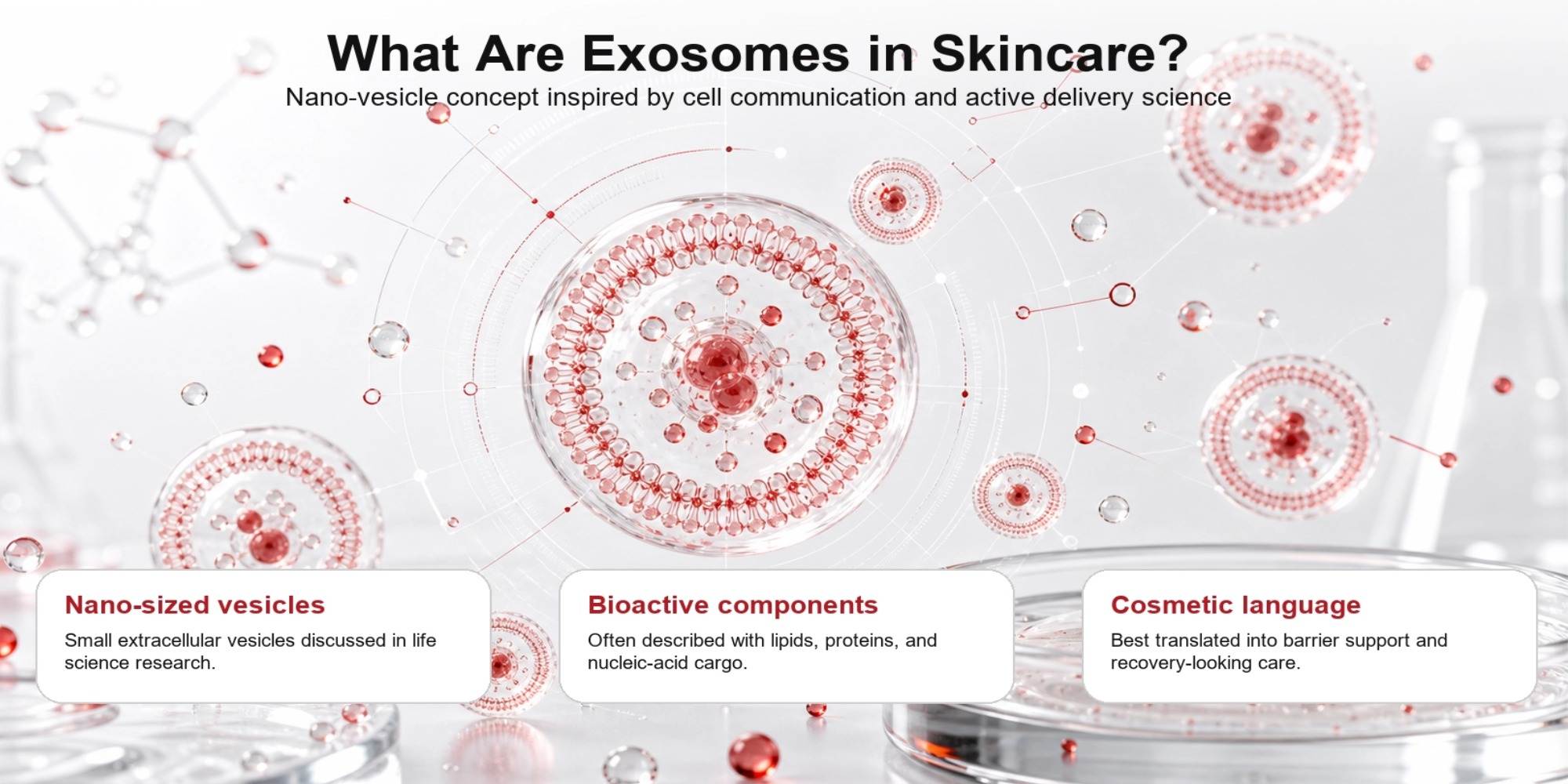
1. What Are Exosomes, and Why Do They Fit Skincare Communication?
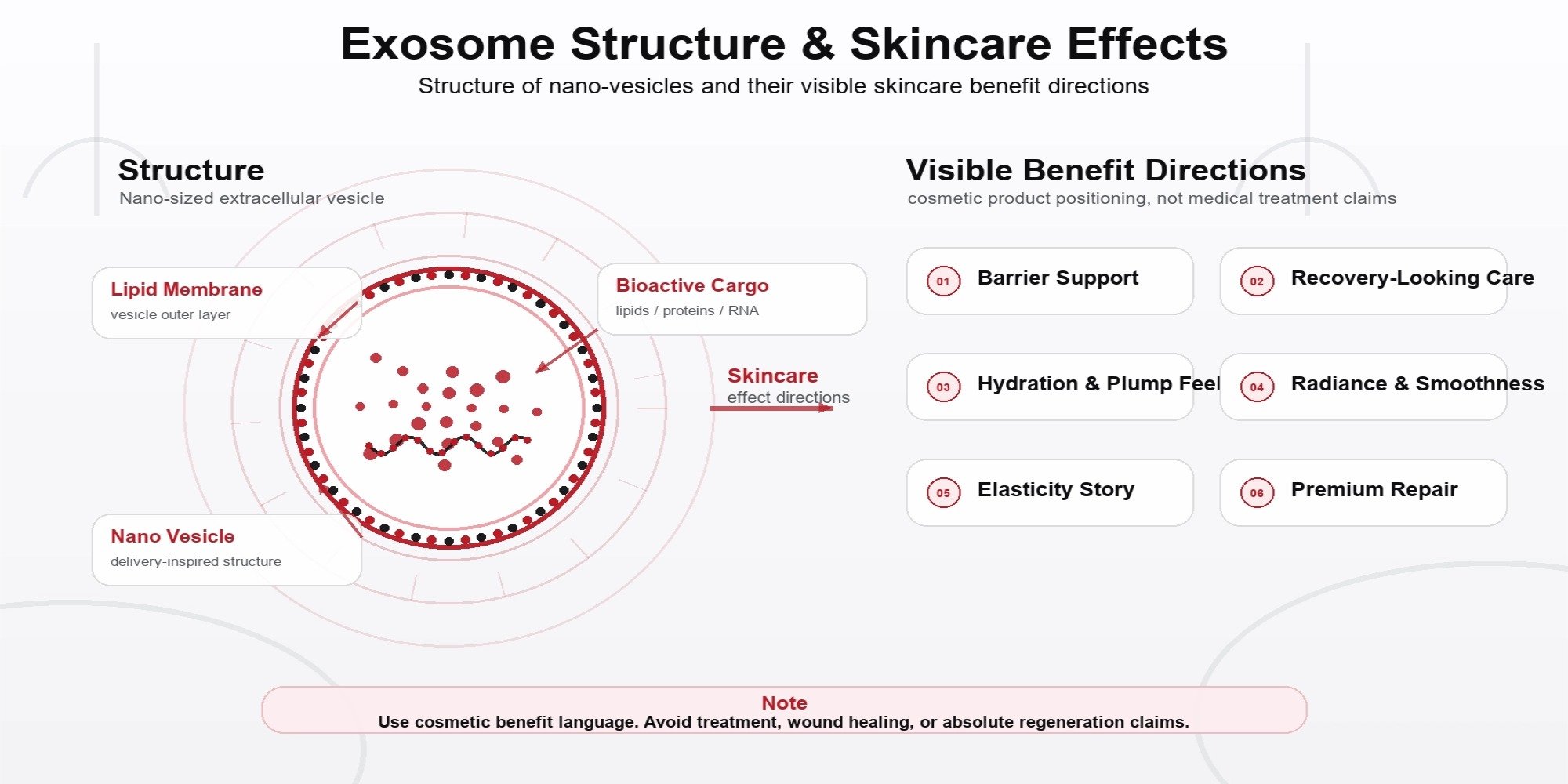
Exosomes are commonly described as nano-sized extracellular vesicles released by cells. They are generally discussed as carrying bioactive components such as lipids, proteins, and nucleic acids. In scientific contexts, exosomes are often connected with cell-to-cell communication.
For cosmetics, the important point is not to turn exosomes into a medical treatment claim. Brands should avoid wording such as cell repair, tissue regeneration, inflammation treatment, or wound healing. These expressions may be too medical for skincare communication.
A safer and more useful way is to translate exosomes into cosmetic-friendly language: biotech-inspired skincare, nano-vesicle concept, advanced repair story, barrier support, recovery-looking care, healthier-looking skin, smoother and more radiant-looking complexion, and premium anti-aging care.
This is why exosome concepts are especially suitable for serums, ampoules, recovery creams, repair masks, and premium skincare sets. These product formats can better carry the value of a high-tech active story than low-perception categories.
2. Why Milk Exosomes Are Easier to Turn into a Consumer Ingredient Story
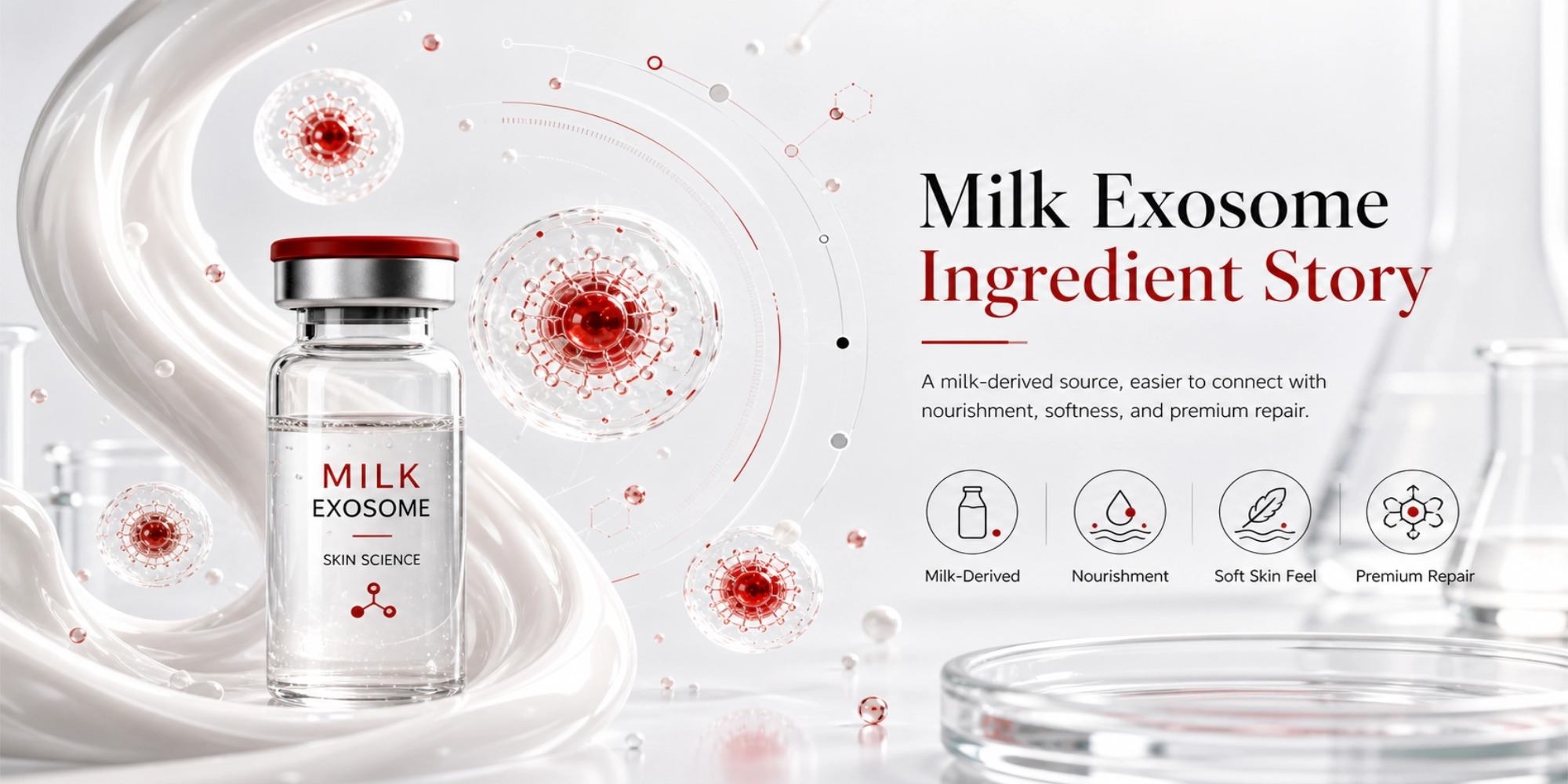
Milk exosomes, also called milk-derived exosomes or milk extracellular vesicles, are extracellular vesicles naturally present in milk. Public research often describes milk-derived exosomes as containing lipids, proteins, and microRNAs.
For consumers, the word exosome can sound highly technical. Milk exosome is easier to understand because milk already carries familiar associations: nourishment, softness, comfort, gentle care, skin nutrition, and premium repair.
This source story matters for brands. A product does not sell only because an ingredient is advanced. It also needs to be easy to explain on an independent website, product detail page, short video, spa sales script, or private label packaging.
A milk exosome serum may be positioned around dry and rough-looking skin, weak barrier feeling, tired-looking complexion, post-care daily skincare, smoother-looking skin, plumper-looking skin, and premium repair care. For customers who want a different source story, Aisen also has plant-derived active vesicle recovery serum development experience and milk exosome product reserves.
3. Exosome Products Should Not Only Talk About High Technology
Many brands want to describe exosome products with words such as high-tech, advanced, biotech, and nano-vesicle. These words can attract attention, but consumers still need to understand what the product is for.
The real question is: does the product fit dry skin, tired-looking skin, post-care routines, barrier support, anti-aging, brightening repair, or sensitive skin comfort? If the product only stays at the technical level, it may sound advanced but still feel hard to buy.
This is why exosome communication should move from technical terms to skin-feel language. The product story should help customers understand when to use it, what skin condition it supports, and why it is different from a basic repair serum.
4. What Brands Often Overlook When Developing Milk Exosome Products
The challenge of exosome product development is not only finding an ingredient. Many customers focus on samples, price, and ingredient story at the beginning, but real launch preparation requires more decisions.
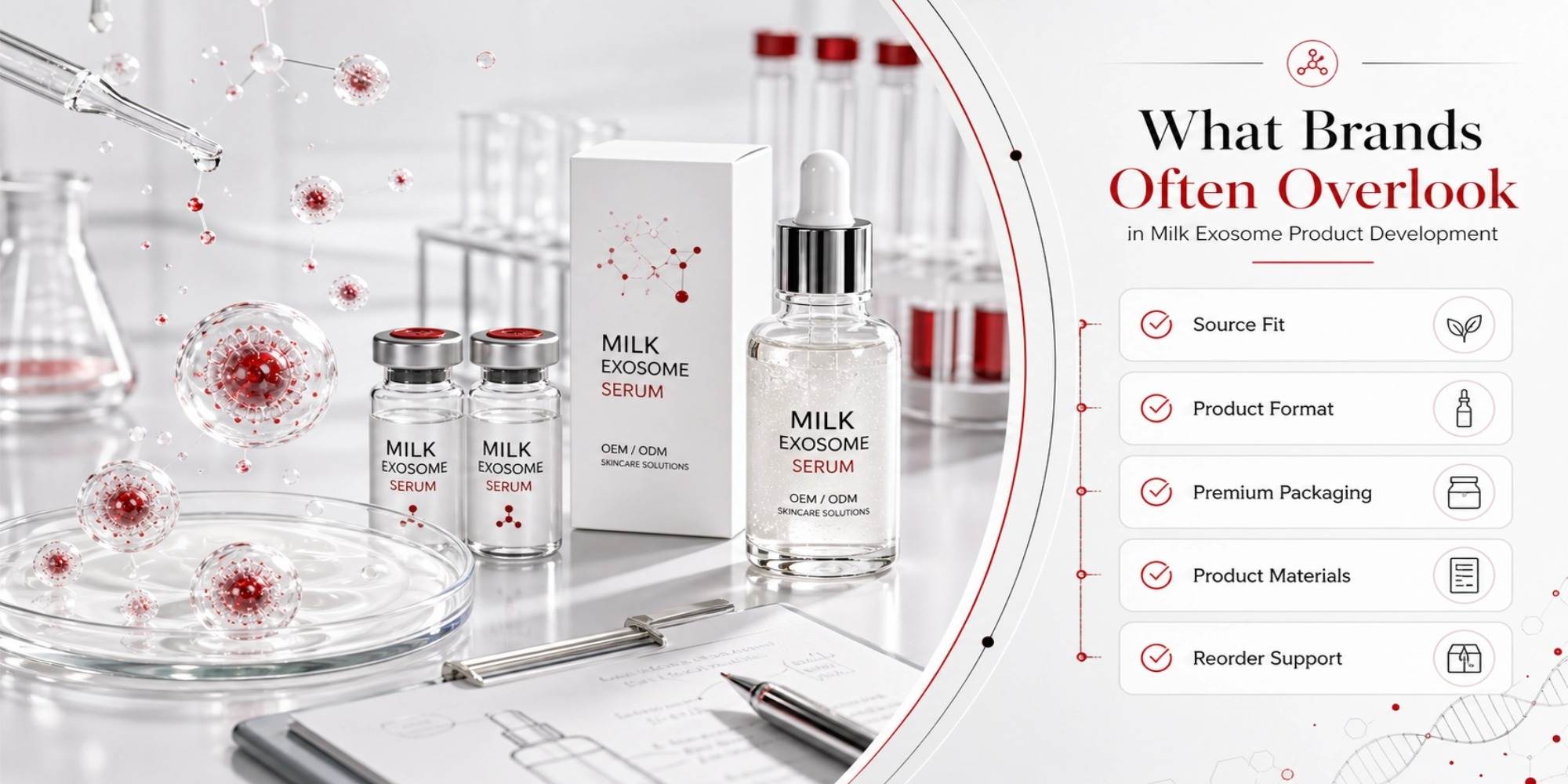
First, the source story should match the target market. Milk exosomes are suitable for premium repair, nourishment, spa care, anti-aging repair, and milk-derived technology stories. However, they may not be suitable for brands that focus strictly on vegan, plant-based, or botanical positioning.
Second, the product format should carry the ingredient value. Exosome concepts work better in serums, ampoules, recovery creams, masks, and repair sets than in low-value perception formats. Packaging should also support the premium story, such as ampoules, vials, droppers, airless pumps, or high-end sets.
Third, product materials should be prepared before launch. Ingredient lists, specifications, COA, MSDS, label support, packaging files, carton information, and export documents can directly affect listing speed, importer communication, and channel trust.
Fourth, brands should think beyond the first sample. If the product sells well, stable replenishment, batch consistency, packaging adjustment, and long-term supply become very important.
5. From Concept to Product: How Aisen Supports Exosome Skincare Development
For many B2B customers, the difficulty is not whether the exosome concept sounds attractive. The difficulty is turning that concept into a real skincare product that can be sampled, listed, exported, sold, and replenished.
Aisen Pro Skin already has a Next-Gen Exosome Technology Plant Peptide Recovery Serum solution featuring plant-derived active vesicles, plant peptides, ceramides, and hyaluronic acid. It is suitable for barrier support, sensitive skin care, daily recovery, and private label development. At the same time, Aisen also has milk exosome product reserves and can develop milk exosome serum, exosome ampoule, recovery cream, repair mask, post-care skincare set, and private label exosome skincare lines according to customer needs.
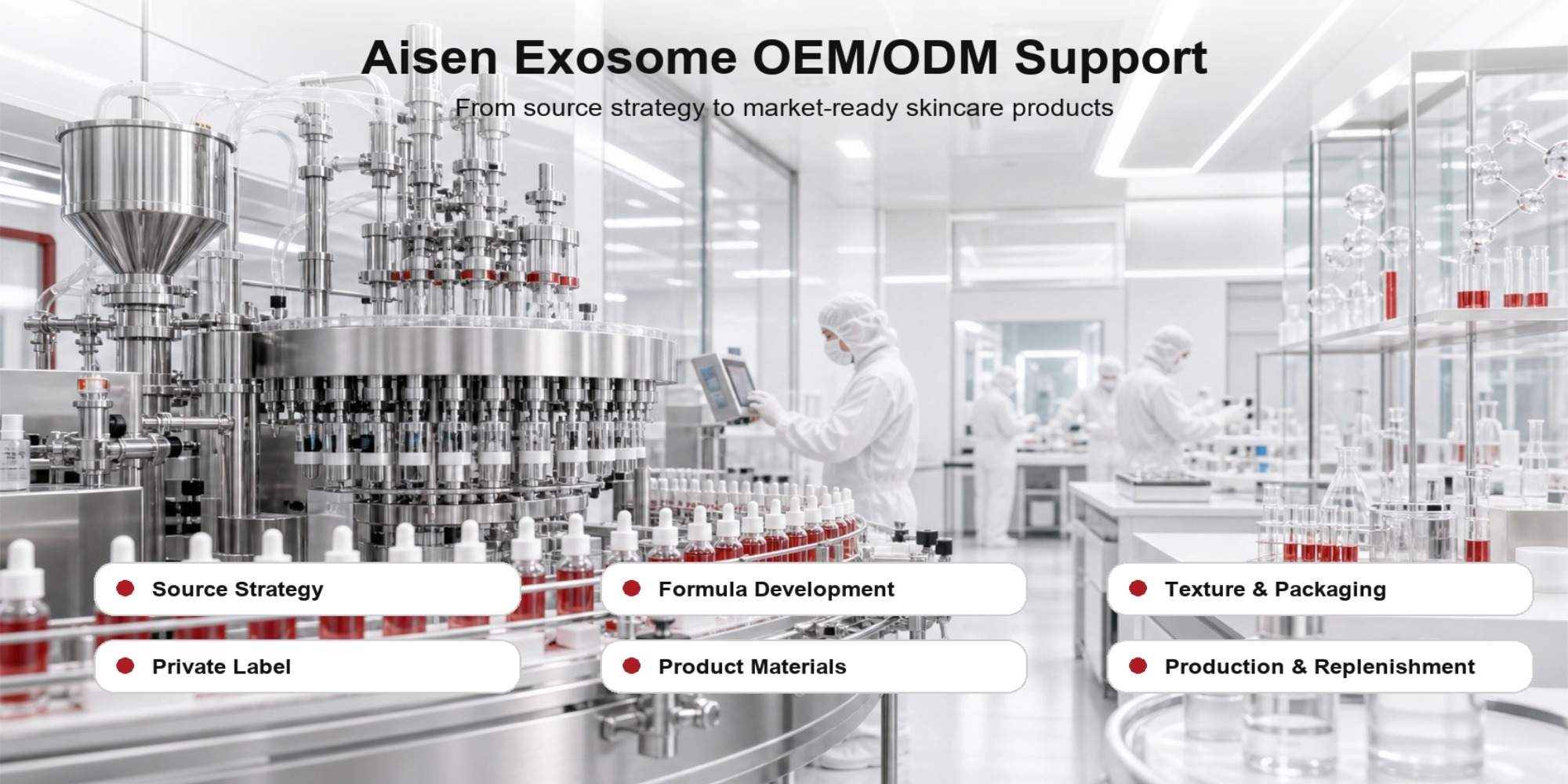
Aisen can support source strategy, formula development, texture adjustment, packaging selection, private label customization, product materials, export documents, and replenishment planning. The value is not only offering a trending concept, but helping customers turn that concept into a product development solution.
In factory capability, Aisen has 3,000+ mature skincare formulas, 12 automated production lines, a 100,000-grade clean workshop, GMPC and ISO 22716 standards, and annual capacity of up to 80 million units. These capabilities support global customers from sample development and trial orders to scaled production and stable replenishment.
Conclusion: Understanding Exosomes Helps Brands Develop Better Exosome Products
Exosome skincare is attractive not only because it is a new word. It is attractive because it can support a high-tech repair, barrier care, anti-aging, and post-care product story. Milk exosomes add another advantage: a source story that consumers can connect with nourishment, softness, and premium repair.
For B2B customers, the key is not only choosing a trending ingredient. It is choosing the right source, product format, packaging, documentation support, export preparation, and factory capability.
If you are developing a milk exosome serum, exosome ampoule, recovery cream, repair mask, or private label exosome skincare line, share your target market, sales channel, source preference, packaging needs, and order quantity with Aisen. Aisen can recommend a suitable OEM/ODM/OBM exosome skincare solution for global markets.
Related products
China Anti-Aging & Brightening Salmon PDRN Facial Serum Supplier | aisenproskin.com
China Bakuchiol Peptide Firming Serum Gentle Sensitive Skin Supplier | aisenproskin.com
China Natural Whitening Goat Milk Soap Bar Rose Carving Supplier | aisenproskin.com